The topic in general
In recent years, attention to the issue of “space weather,” that is, the space meteorological conditions originating from solar activity, has increased significantly. The phenomenon is driven by the Sun, and when the Sun is highly active (as during this period, namely the peak of solar cycle ’25), events such as geomagnetic storms, solar flares, and ionospheric disturbances may occur.
These events have real and potentially significant impacts on the technologies used in flight (satellites, HF and SATCOM communication systems, GNSS for navigation and surveillance), and they may also increase radiation exposure for passengers and crew.
Other particular cases — foremost among them the recent one involving the Airbus 320 — have received considerable media coverage and were promptly addressed by the competent Institutions (for further details: Link).
For modern civil aviation, awareness and availability of information on this matter are essential to ensure the safety, efficiency and regularity of flights. It is equally important that the general public can rely on precise, up-to-date and trustworthy sources of information on the topic.
For further details: World Meteorological Organization.
The new regulatory framework: the evolution of ICAO’s “space weather” information service
With the recent adoption of Amendment 82 to ICAO Annex 3, effective from 27 November 2025, the obligation for Contracting States to provide a meteorological information service that includes “space weather” is formally established.
Together with Amendment 82, the first edition of PANS MET (Doc 10157) has also entered into force, setting out the procedures and technical specifications for the provision of aeronautical meteorological service, including the “space weather” service.
This regulatory framework renders operational and mandatory the global space weather information service (SWIS – Space Weather Information Service), currently managed by designated centres (global and regional) that constantly monitor solar activity and ionospheric conditions, issue advisories (SWXA) for the benefit of aircraft, airports, air traffic controllers, and meteorological centres, operating with 24-hour shifts, mutual back-up and global coordination.
For further details: Link.
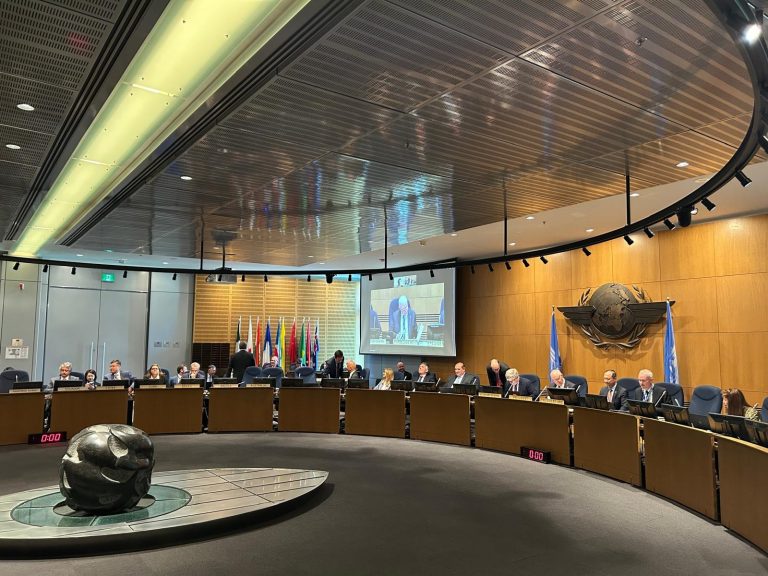
The global scenario: the “space weather” theme at the centre of ICAO’s 236th Council Session
During the 236th Session of the ICAO Council, held between October and November 2025, the new standard established through Amendment 82 to Annex 3 was confirmed, including the strengthening of the SWIS (space weather information service) for the entire civil aviation sector worldwide. In the discussion, it was highlighted how, thanks to SWIS and to the designated global/regional centres (global/regional SWXCs), it is possible to ensure continuous surveillance — 24 hours a day, 7 days a week — of solar and ionospheric activity, and to provide operational advisories to airports, air traffic service providers (ATC), airlines and crews, in a globally coordinated and harmonized manner.